Highfields & the north
Lawn mowing and garden care in Highfields from a local crew: we're based right here on Highfields Rd, not driving out from the city, so we know the red soil, the frosts and how a lawn behaves up here through the year. TopLawn is family-owned, police-checked, $20M insured, 80+ five-star reviews.
★★★★★
They have been taking care of my yard in Highfields with mowing, edging and weed spraying now for several months and I have found them to provide a high quality, reliable service at a great price. Highly recommend!
★★★★★
Prompt, reliable and flexible — I especially love the reminder text the day before they come!! They're also proactive in managing problems before they become problems.
Why us here
Being based in Highfields means you're on our doorstep, not the far end of a route that runs through six other suburbs first, so scheduling is easy. At around 700 m, winter brings frosts and a real cool-season slowdown, and the red soil drains freely but dries at the surface, so we plan for both. We match the machine to the block too: the commercial-grade zero-turn for the larger acreage lawns toward Cawdor and Kleinton, a commercial push mower for medium-to-large house blocks, and a compact push mower for the tight, hard-to-access spots.
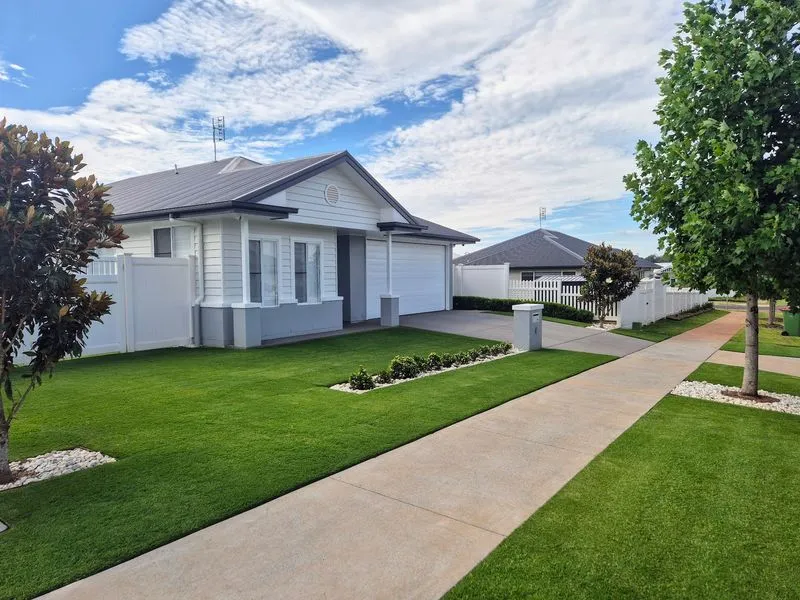
Recent work in Highfields: ongoing mowing, bladed edging and weed spraying on house blocks, acreage cuts with the zero-turn on the bigger blocks, and hedge trimming. Both photos are our own Highfields jobs.


What your lawn is telling you
Water beading and running off dry patches is the free-draining red soil turning water-repellent, and a wetting agent fixes it. Spongy underfoot means thatch, ready to scarify. Grass browning first on the shallower, steeper ground wants the taller recommended cut and deeper watering. Pale, slow growth wants feeding, and clover spreading is usually the same low-nitrogen message. Golden patches that lift like carpet in summer can be lawn grubs: for lawns on one of our programs, we arrange treatment through our licensed pest partner.
Commercial-grade zero-turn, commercial and compact push mowing · bladed edging and whipper snipping · hedge trimming and shaping · aeration and wetting agent application · lawn fertilising and selective weed control · lawn pest and grub treatment through our licensed pest partner (for lawns on one of our programs) · garden maintenance and clean-ups · green waste removal.
We're a family-owned team mowing lawns across Toowoomba and surrounds. Read about our lawn mowing services in Highfields, plus acreage and rural mowing, hedge trimming, tree pruning, weed control, garden maintenance, yard cleanups, lawn care and renovation and garden landscaping. We look after homes with residential lawn and garden care, and businesses with commercial grounds maintenance.
Common questions
Free quotes on every job. The main factors on a Highfields block are lawn size (acreage takes the zero-turn), access (tight or gated areas may need the compact push mower), how often you'd like us (ongoing weekly, fortnightly or monthly is priced better than one-offs), the condition it's in when we start, and any extras like aeration, wetting agents, fertilising or garden work.
Block sizes: half the blocks in Highfields are between 900 and 3,000 m², and the median is about 2,500 m² (Queensland Government land parcel data, October 2026).
Nearby areas we also service
For the numbers, see what lawn mowing costs in Toowoomba and how our quoting works.
We're based in Highfields, so the north side is our home patch. Our north-side area covers Kleinton, Cabarlah, Cawdor, Meringandan and Meringandan West, up to Hampton, Ballard, Blue Mountain Heights and Mount Kynoch, and across to Gowrie Junction. Blocks get bigger the further out you go, from house blocks in Highfields and Kleinton to acreage around Cabarlah and Gowrie Junction, and the red basalt soil around Highfields gives way to heavier black clay toward Meringandan and Gowrie.
Written from our own jobs across the region, not copied from a national site: spring lawn recovery in Toowoomba, how often to mow a Toowoomba lawn, and which grass types suit Toowoomba. If your block is on black soil, read why it cracks in summer and bogs in winter and when core aeration is worth doing. If it is red soil, read why water beads off dry patches. More in the lawn care advice hub.
Lawn conditions here
Red Ferrosol (basalt) · shallow red-brown clay on scarp country
Government soil mapping shows Highfields on deep red Ferrosol (krasnozem) formed on basalt at every point checked across the suburb, with shallower red-brown clay mapped on the steeper scarp country to the south. It's excellent, well-structured soil, but because it drains so freely, on slopes and through summer heat the surface can dry out and even turn water-repellent, leaving patches where water beads and runs off instead of soaking in. If your lawn has dry patches that won't take water no matter how much you give them, that's the tell: a wetting agent breaks that repellency so the soil absorbs and holds moisture again, and aeration improves how deep that water gets. On the shallower scarp ground, the taller recommended cut and deep, less frequent watering help. Kikuyu holds its colour into the cool months, and Sir Walter buffalo is popular for its frost tolerance and soft feel on the shadier treed blocks; couch and TifTuf appear on sunnier open blocks, with fescue on cooler shaded sites. Winter grass and bindii are the cool-season weeds, and warm-season grass goes golden and dormant after a frost: normal, not dead.
Highfields sits on the Great Dividing Range about 15 km north of the Toowoomba CBD, just north of Mount Kynoch, at around 700 m and on the New England Highway. Suburban housing fills the centre of the locality, with grazing and cropping country on the outskirts, so jobs run from compact estate lawns and established family blocks through to acreage toward Cawdor and Kleinton.
It's still growing: the population went from 8,131 at the 2016 census to 8,568 in 2021, across 3,241 dwellings, almost all of them separate houses. Sawmills opened the area up in the 1860s, dairy farms followed as the land was cleared, and residential subdivision began in the 1960s. Winters are cool up here: the long-record Toowoomba weather station (691 m, closed 2007) averaged about 14 nights a year at or below 2 °C and 952 mm of rain.
Through the year
Get in touch with James
Tell us about your lawn and we'll price it properly. Most quotes come back within 1 business day, and many can be done from photos without us visiting first.
See everything we do — our full service list →